A/B side power and N+1 cooling redundancy network-wide, Tier III-grade design at our flagship facilities, and GPU-ready rack configurations throughout.
Why Power is The Product
In data centre real estate, power is the utility that determines what a building can actually support. Connectivity and physical space are table stakes. The question that matters for AI and HPC workloads is kilowatts per rack, and what happens when the utility grid doesn't.
Hut 8 Canada's facilities are engineered around power: its delivery, its redundancy and its density. Every design decision flows from the assumption that the hardware inside is mission-critical and that interruption is not acceptable.
Partner Quotes
Power Infrastructure - Redundant by Design
Redundant Utility Feeds
Every Hut 8 Canada facility receives primary power from municipal hydro substations with A and B side power delivered to every cabinet as standard, eliminating single points of failure at the utility level. Mississauga goes further with two independent municipal substation feeds, and both flagship facilities run full 2N power redundancy end to end.
Backup Generation
On-site diesel generation provides seamless transfer during grid events at every facility. Mississauga runs ten generators (7,000 kW total) with fuel capacity exceeding 24 hours at full load; Kelowna runs two 1,500 kW generators (3,000 kW total) with fuel capacity exceeding 29 hours. Vaughan runs three generators (1,125 kW total, >28h); Vancouver Vault runs a 600 kW generator with a 22,000 L tank (>48h); our downtown Vancouver facility runs dual generators (435 kW total, >24h).
Uninterruptible Power Supply
UPS systems bridge the gap between utility interruption and generator pickup, protecting hardware from power quality events including sags, swells and momentary outages. Mississauga runs 900 kW per side in a 2N configuration; Kelowna runs 1,000 kW per side with N+1 redundancy. UPS capacity is sized to each facility's designed load network-wide.
A and B Side Power to Every Cabinet
Dual-corded servers and storage systems can draw from independent power paths simultaneously. Hut 8 Canada delivers both paths to every cabinet as standard, not as an upgrade, across all five facilities.
Dual feeds with A/B side power network-wide; Mississauga on two independent substations
On-site diesel at every facility — Mississauga 7,000 kW, Kelowna 3,000 kW, Vaughan 1,125 kW, Vancouver Vault 600 kW, Vancouver 435 kW
Mississauga 900 kW/side (2N); Kelowna 1,000 kW/side (N+1); sized to load elsewhere
N+1 cooling and A/B power network-wide; full Tier III-grade 2N design at Mississauga and Kelowna
Up to 135+ kW per rack at Mississauga and Kelowna; GPU-ready configurations elsewhere — contact us
24/7 infrastructure monitoring; environmental sensors throughout
Cooling Infrastructure
Cooling is the constraint that most colocation providers understate. Standard IT racks run at 3–5 kW. An NVIDIA DGX H100 system requires 10.2 kW. A dense GPU cluster can exceed 40 kW per rack. Standard cooling architectures fail at these densities.
Cooling That Scales With Density
N+1 Cooling Redundancy
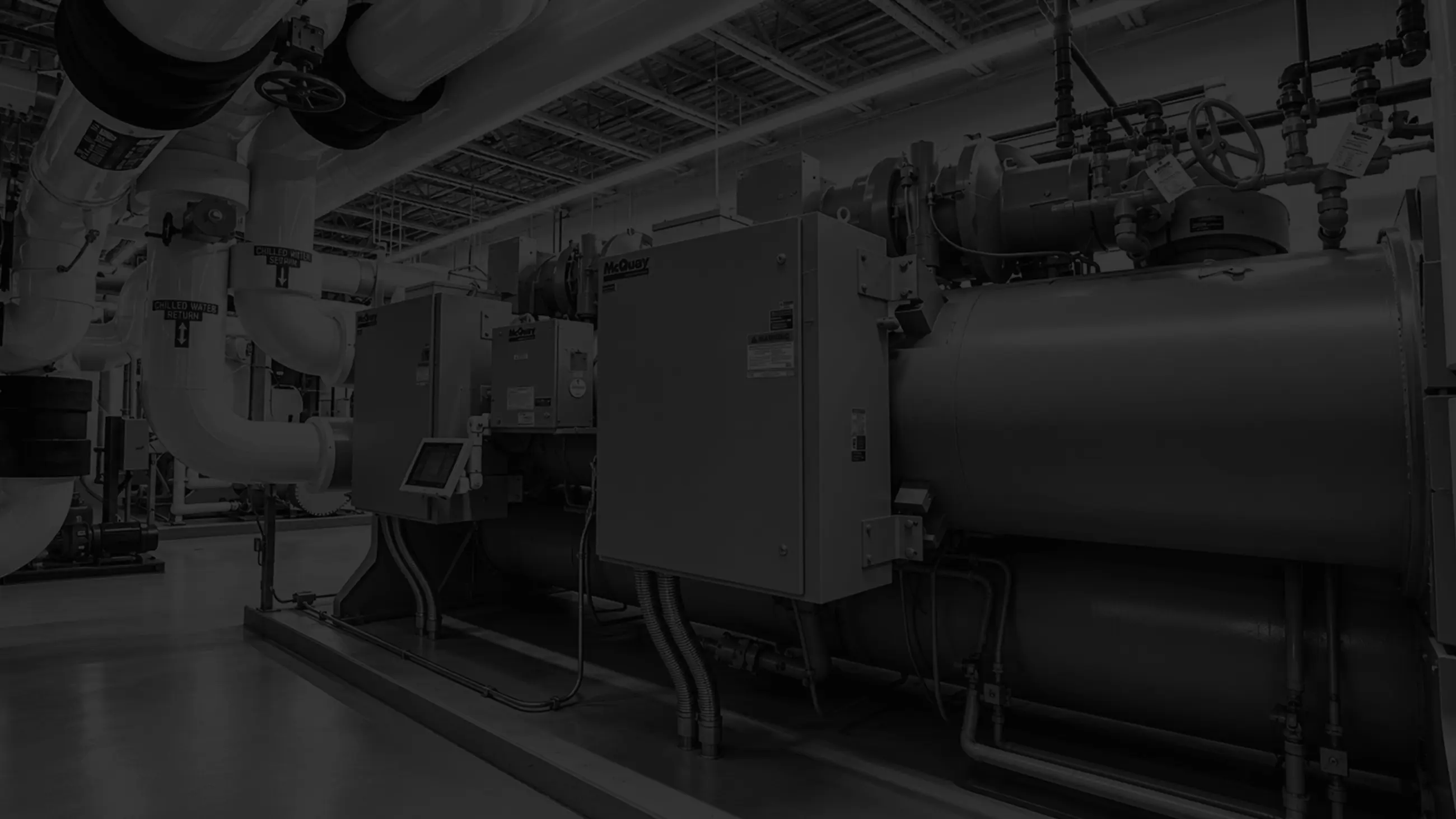
Every Hut 8 Canada facility is designed with N+1 cooling redundancy; sufficient additional cooling capacity that any single unit can fail without impacting the cooling delivered to the floor. Hot-aisle containment is standard network-wide; Vancouver Vault runs a chilled-water closed loop with outdoor chillers, while our other sites use commercial-grade modular or CRAC-based systems sized to each facility's load.
High-Density Cooling Configurations
GPU-ready rack positions are engineered with cooling appropriate to the power density they support. Hot-aisle/cold-aisle containment is standard. High-density zones with in-row or rear-door cooling are available at select sites. Contact us with your hardware spec to confirm density availability at the site you are evaluating.
Environmental Monitoring
Temperature, humidity and power draw are monitored continuously across all facilities. Anomalies are detected and escalated before they become incidents.
Power As a Planning Unit
Before specifying space, specify power. The right question when evaluating a colocation deployment is not "how many racks?" but "how many kilowatts?" — and then "what is the path to more if we grow?"
Hut 8 Canada's sales team approaches every conversation this way. We will ask about your hardware, your current density and your 18-month growth plan before discussing space configurations. It is the only way to ensure the facility we put you in can support you as your workload evolves.