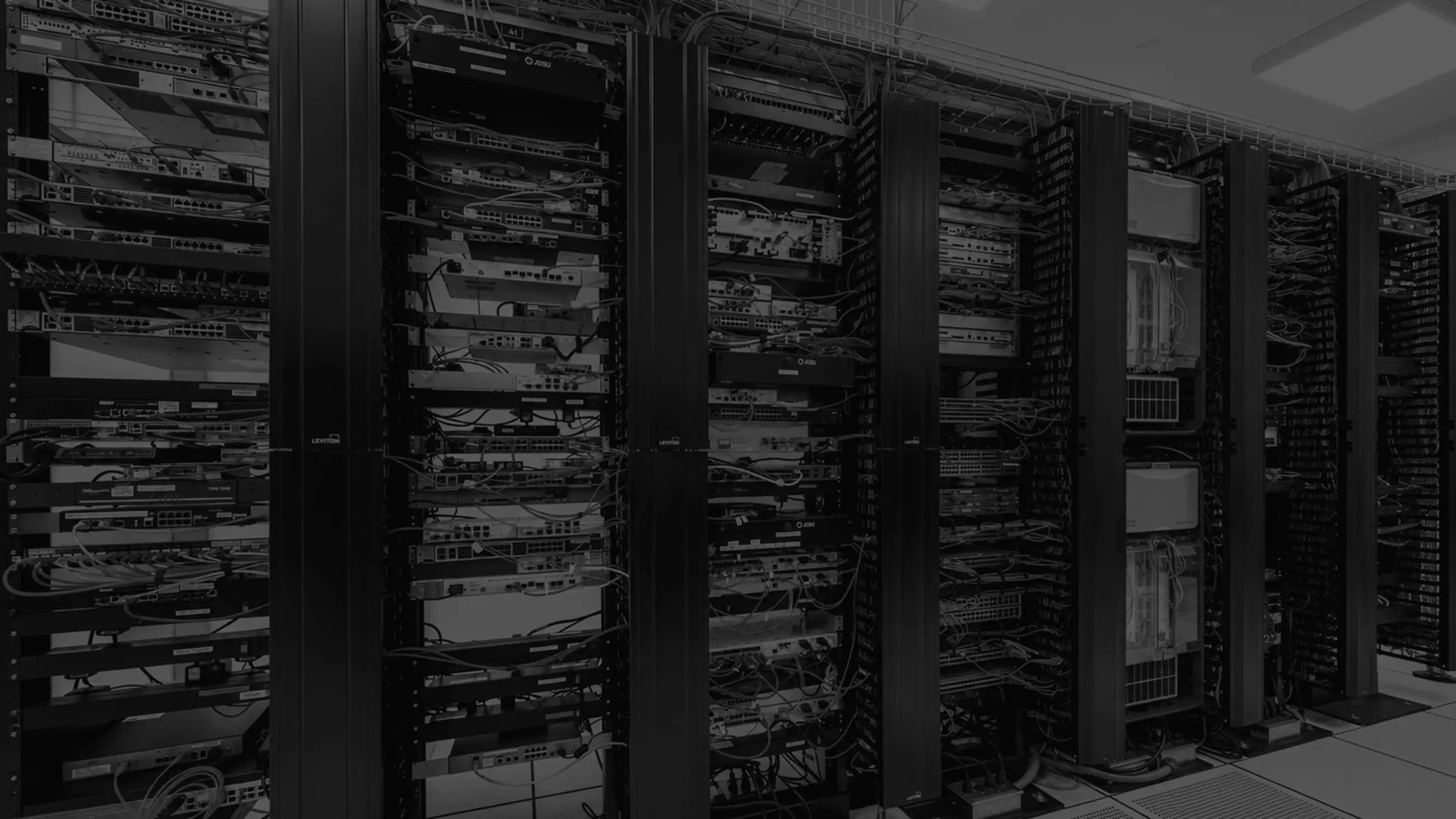
Cross-connects, dark fibre and a carrier-neutral environment that gives you network choice without compromise.
Network As Infrastructure
Connectivity is the third pillar of the data centre real-estate model. Space and power determine what you can run. Connectivity determines how quickly it can be reached, and by whom.
Hut 8 Canada's facilities are carrier-neutral. We do not own a network and we do not have a preferred carrier relationship that creates pressure to use one. Our role is to provide the physical environment; conduit, patch panels, meet-me rooms, and to ensure the widest possible range of carriers can reach your hardware with the least friction.
Partner Quotes
Connectivity Services
Cross-Connects
A cross-connect is a direct physical connection between your equipment and another party; a carrier, an internet exchange, another tenant, or your own equipment in a different cage. Hut 8 Canada provides cross-connects as a facility service with defined SLAs for provisioning.
Cross-connects eliminate the latency, cost and single-carrier dependency of routing traffic outside the building and back in. For latency-sensitive workloads, they are often the difference between meeting and missing performance requirements.
Dark Fibre Between Sites
Hut 8 Canada's five facilities are connected by a 100G national backbone. In British Columbia, this backbone is deliberately used for disaster recovery: both our downtown Vancouver facility and Vancouver Vault connect directly to Kelowna over 100G dark fibre, giving BC tenants a fully managed, within-network DR pairing with one of North America's lowest geographic risk profiles. The same backbone links our GTA data centers and connects every site to the network as a whole.
Dark fibre between sites is the infrastructure that makes a multi-site colocation strategy operationally coherent; low-latency, high-bandwidth, with no per-gigabyte billing.
Internet Exchange Access
Hut 8 Canada facilities provide access to Canadian internet exchanges, enabling tenants to peer directly with major content and transit providers and to reduce last-mile latency for Canadian end users.
Carrier-Neutral Meet-Me Room
All facilities are carrier-neutral. Mississauga carries the deepest bench in the network; Rogers, Bell, Zayo, Cogent and Telus all on-net, one of the highest carrier density in the GTA colocation market. Kelowna offers Bell, Telus, Zayo and Rogers. Zayo is also on-site at Vaughan and Vancouver Vault; Shaw and Rogers are on-site at our downtown Vancouver facility. New carriers are added on request at any site.
Carrier-neutral at all five sites
Available; provisioned with defined SLA
100G national backbone connecting all five facilities
Kelowna ↔ Vancouver and Kelowna ↔ Vancouver Vault, both via 100G dark fibre
High-capacity; no per-gigabyte billing on dark fibre inter-site paths
Mississauga: Rogers, Bell, Zayo, Cogent, Telus (5) · Kelowna: Bell, Telus, Zayo, Rogers (4) · Vaughan & Vancouver Vault: Zayo · Vancouver: Shaw, Rogers
Network Monitoring and Management
Hut 8 Canada's on-site teams monitor physical network infrastructure; patch panels, cross-connect integrity, meet-me room access; continuously. Network incidents at the physical layer are escalated through our 24/7 operations process.
For tenants who want their own network managed, not just the physical plant, that falls under Tenant Services (Remote Hands and Managed AI). See the Tenant Services page.
Multi-Site Connectivity Strategy
Hut 8 Canada's five sites give tenants the ability to build a genuinely Canadian multi-site strategy; primary in the GTA, secondary in BC, or distributed across both regions; with a single landlord relationship and a private inter-site network.
Built For a Genuinely Canadian Footprint
Financial Services
Active-active or active-passive DR across Ontario and BC.
Healthcare
Provincial data residency with geographic redundancy.
AI Workloads
Training in one region, inference closer to end users in another.
Board-Mandated Resilience
No single site failure takes down all operations.