Why We Built the Complete AI Stack for Canadian Enterprise, and Why We Couldn't Do It Alone
06.10.2026
For years, the conversation about enterprise AI in Canada has been stuck in the same place. Organisations know they need to move. The business cases are compelling. The technology has matured. And yet, when you look at how many Canadian enterprises have successfully moved AI from pilot to sustained production, the number is smaller than the noise in the market suggests.
The gap between enterprise AI ambition and production reality has been hiding in plain sight. Here is what we saw, what we built, and why the partnership with Cylix Applied Intelligence makes it possible.
The gap nobody was talking about honestly
Enterprise AI doesn’t fail because the models aren’t good enough. It fails because building and operating the full stack; data engineering, compute infrastructure, model training, deployment, security, compliance, and ongoing operations, requires a combination of expertise that almost no organisation has entirely in-house. And the vendors serving different parts of that stack rarely take responsibility for how the pieces fit together.
The result is a fragmentation problem. A data vendor. A compute vendor. An AI consultancy. A managed services provider. Each doing their part, none owning the outcome. And when something goes wrong in production, when a model drifts, a pipeline breaks, an inference latency issue emerges; the accountability gap opens up and the client is left holding it.
We saw this pattern repeatedly in conversations with Canadian enterprise clients. The question that kept surfacing wasn’t “should we do AI?” It was “who is actually going to be responsible for making sure it works, not just at launch, but six months later?”
The question wasn't whether to do AI. It was who would own the outcome when something went wrong in production six months after launch.
What Hut 8 Canada brings, and where the gap was
Hut 8 Canada's strength has always been infrastructure. Enterprise-grade Canadian data centres. Tier III redundancy. The physical and network foundation that demanding workloads require. When AI became the most consequential workload our clients were planning for, the infrastructure answer was clear: Canadian data-resident GPU compute, built to the same operational standards as everything else we run.
But infrastructure alone doesn't close the gap. A client who comes to us with an AI workload doesn't just need somewhere to run it. They need someone who can build the data pipelines that feed it, train and fine-tune the models that power it, deploy it into production environments, and then stay accountable for keeping it performing as the world changes around it.
That expertise, the AI lifecycle layer, isn't what infrastructure companies are built to provide. We knew that honestly, and it shaped how we thought about what the right answer looked like.

Why Cylix Applied Intelligence
Cylix Applied Intelligence is a North American leader in enterprise AI infrastructure, AI lifecycle management, and high-performance computing. They support some of the world's largest organisations with end-to-end AI advisory, engineering, and operational services. Critically, they have built their practice around exactly the operational discipline that most AI engagements lack — the infrastructure, tooling, and accountability structures that keep AI working in production, not just at launch.
The philosophy aligned immediately. Cylix built their AI lifecycle capability end-to-end precisely because they have seen what happens when it's fragmented. The Hut 8 Canada partnership extends that philosophy to the infrastructure layer, adding Canadian data residency, enterprise-grade compute, and the operational backbone that Canadian organisations in regulated industries specifically require.
The economics that change everything
There is a cost dimension to this that deserves to be stated plainly. Most Canadian enterprises exploring AI at scale are doing so through public API providers, paying for every token processed, every query made, every word in and out of the model. At low volumes, this is manageable. At enterprise scale, it becomes one of the largest and fastest-growing line items in the AI budget.
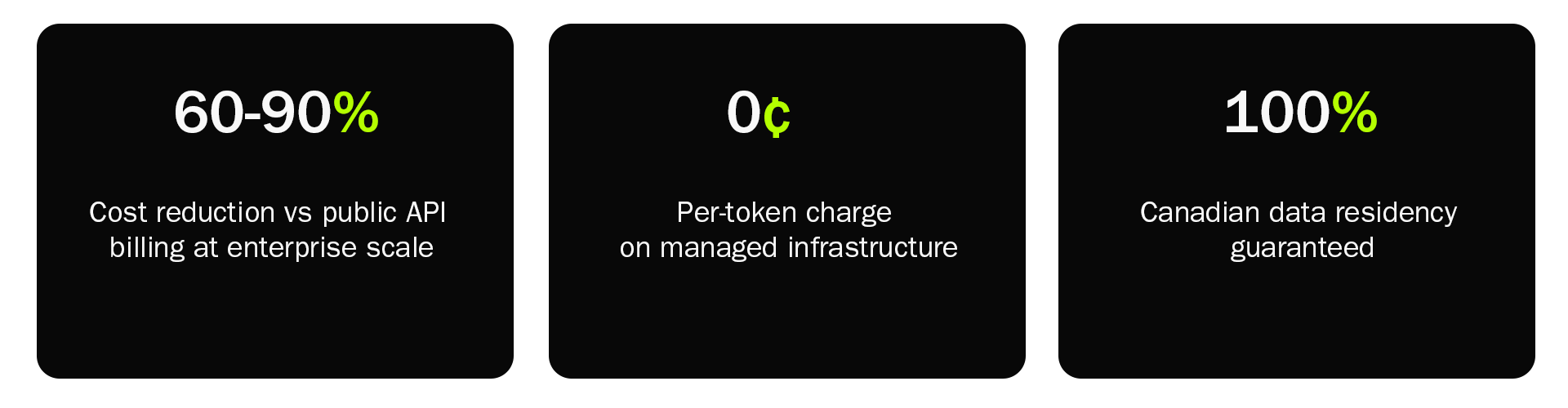
When AI workloads run on owned or managed infrastructure, that dynamic changes structurally. The metered billing model disappears. Costs become fixed and predictable. The more AI you run, the better your unit economics, the inverse of what public API billing produces. Organisations at enterprise scale typically see 60 to 90 percent cost reduction when moving inference workloads to dedicated infrastructure. That isn't a marginal improvement. It is a different economic model entirely.
What the partnership delivers
The Managed AI Infrastructure Solution brings together three phases of engagement under a single accountable partnership. The Assess phase establishes AI readiness, prioritises use cases, and builds the strategic roadmap before a dollar is spent on development. The Build phase delivers the data engineering, model development, and production infrastructure on Canadian data-resident compute. The Manage phase — the one that most engagements lack — provides continuous monitoring, drift detection, retraining, and optimisation so AI keeps working as your organisation and data evolve.
One partner. Every layer. Built for Canadian businesses.