
Data Residency and Toronto Colocation: What Regulated Industries Need to Understand
06.18.2026
Canadian law doesn't always say "keep data in Canada" explicitly. But for organizations in financial services, healthcare, and the public sector, the practical effect is the same; and the gap between compliance and non-compliance often comes down to where your infrastructure physically sits.
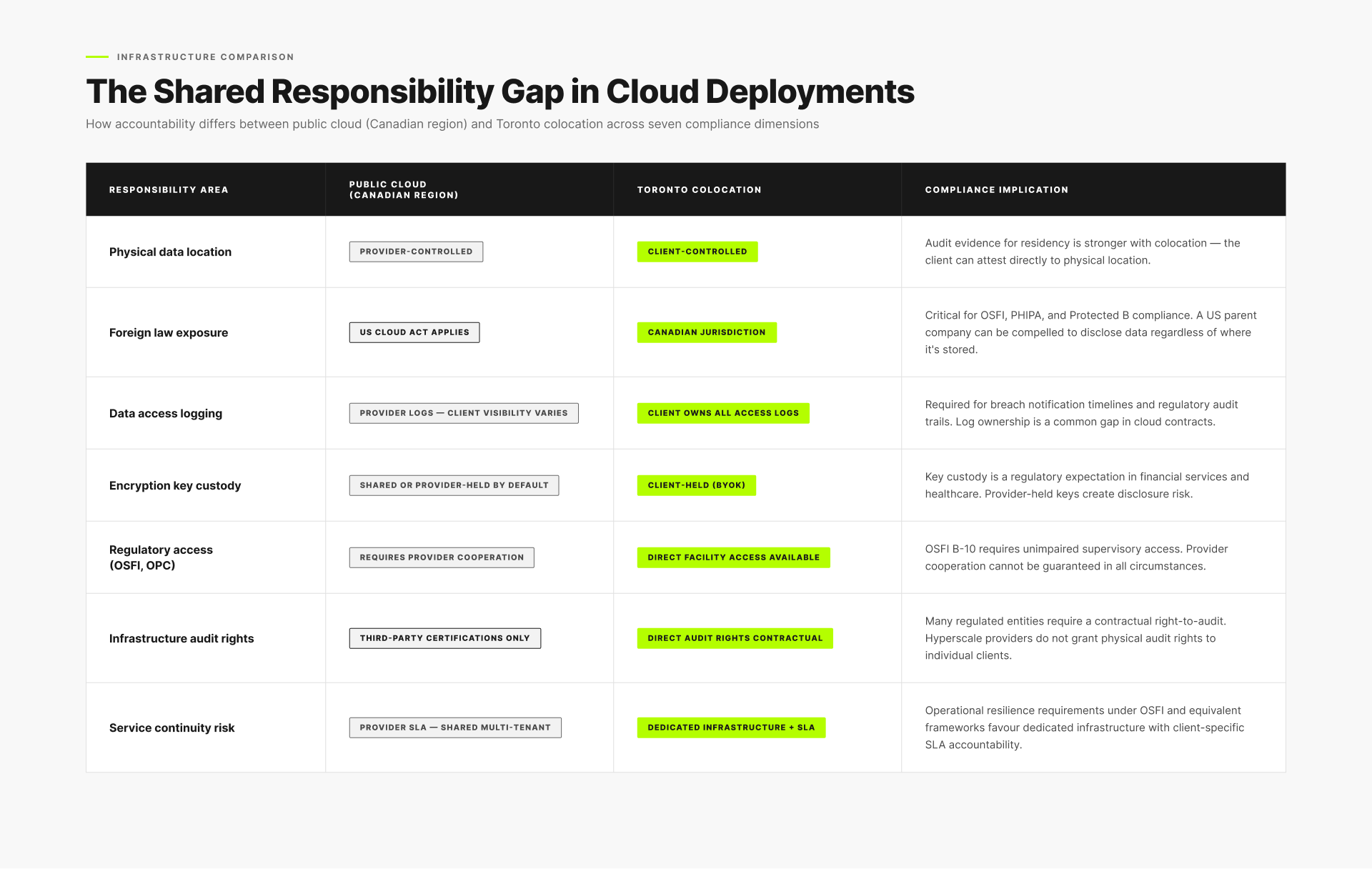
Data residency is one of those compliance obligations that looks straightforward until you try to operationalize it. The instinct is to treat it as a checkbox; data stays in Canada, box checked — but the reality is more layered. Different Canadian regulatory regimes impose different obligations, some explicit and some implied. Cloud providers have added complexity by marketing "Canadian regions" that are technically resident but operationally subject to foreign law. And the shared responsibility model that governs most cloud deployments leaves significant accountability gaps that regulated organizations often don't discover until an audit.
Colocation in a Canadian facility doesn't automatically resolve all of these questions, but it does address the most fundamental one: physical control over where the data lives and who can access it. This article maps the regulatory landscape for Toronto's key industries and explains what that landscape means for infrastructure decisions.
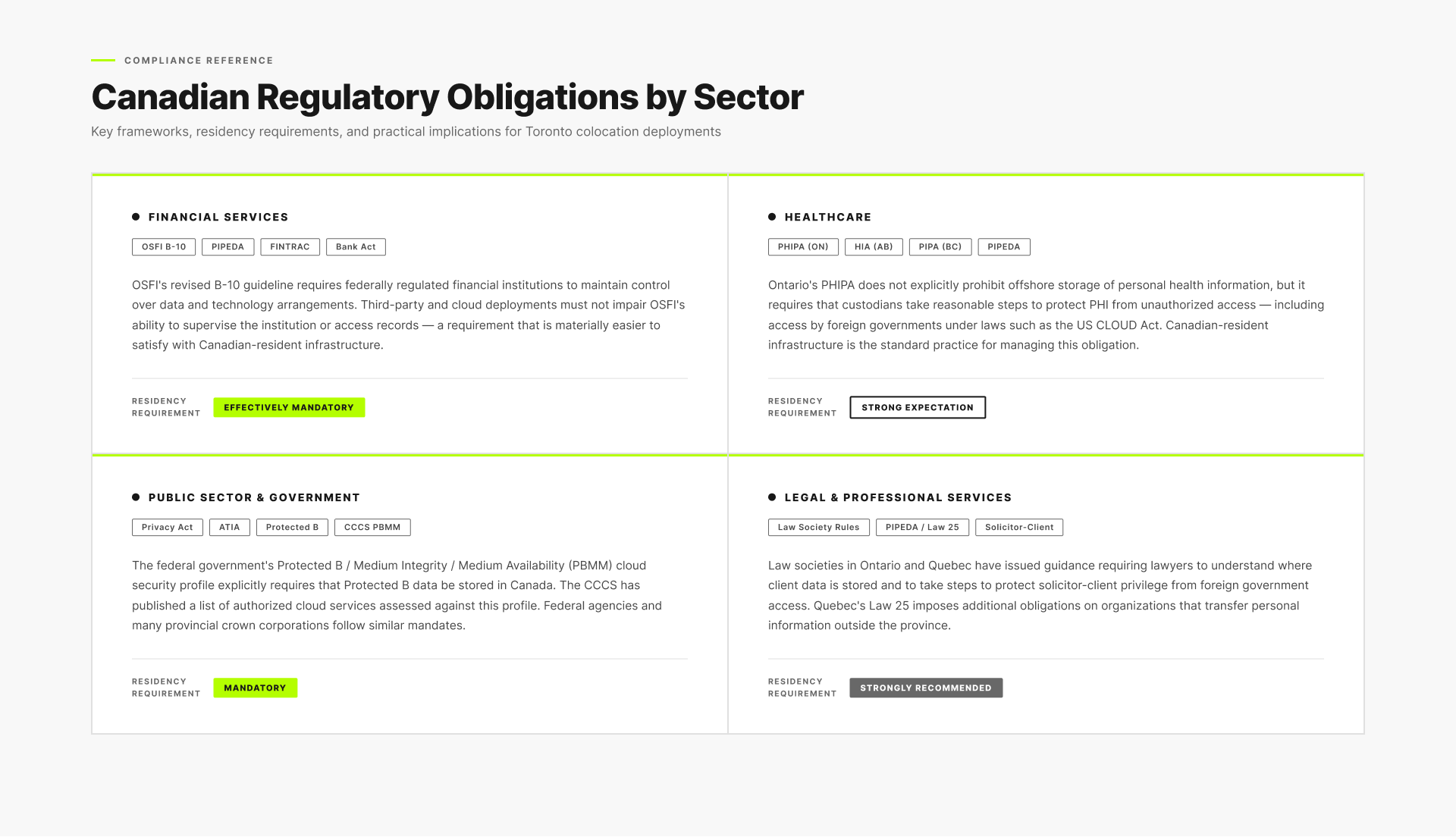
The Regulatory Landscape by Industry
No single Canadian statute imposes a universal data residency requirement. Instead, obligations arise from a patchwork of federal and provincial legislation, sector-specific guidelines, and contractual frameworks; each with different teeth and different interpretations of what "Canadian data" means.
What "Data Residency" Actually Means, and What It Doesn't
Data residency, in its most basic form, means that data is stored on physical infrastructure located within a defined geographic boundary, in this context, Canada. It is distinct from two related but different concepts: data sovereignty and data localization.
Data sovereignty goes beyond where data sits. It concerns which legal jurisdiction governs that data — who can compel access, under what legal process, and with what notice to the data subject. Data can be physically resident in Canada but governed by foreign law if the organization controlling it is subject to foreign jurisdiction. This is the core concern with US-headquartered cloud providers operating Canadian regions: the infrastructure is in Canada, but the parent company is subject to the US CLOUD Act, which can compel disclosure of data stored anywhere in the world without requiring a Canadian court order.
Data localization is a stricter requirement: not just that data is stored in a jurisdiction, but that it is processed there as well, and in some cases that it cannot leave. Canada does not currently have a blanket data localization law, but sector-specific rules — particularly for Protected B government data and certain provincial health frameworks — achieve a similar practical effect.
"A US cloud provider's Canadian region gives you geographic residency. It does not give you sovereignty. Those are different things, and for regulated industries in Canada, the difference matters at audit time."
Regulated Data in Hybrid Architectures
Most enterprises today don't run a single infrastructure model. The practical question for regulated organizations is not "cloud or colo" but "which workloads belong where." A well-structured hybrid architecture places regulated data on Canadian-resident, client- controlled infrastructure while allowing non-regulated workloads to leverage cloud economics where appropriate.
What typically needs to stay on Canadian-resident infrastructure
Personal health information (PHI) under PHIPA, HIA, or provincial equivalents — particularly records that identify individuals and their clinical history.
Protected B and Protected A government data under the federal government's cloud security profile — required to be stored and processed in Canada.
Financial records subject to OSFI oversight — including customer account data, transaction records, and risk management systems at federally regulated institutions.
Solicitor-client privileged materials — particularly where law society guidance requires lawyers to understand and control the storage location of client data.
Quebec personal information subject to Law 25 — where cross-border transfers require a privacy impact assessment and contractual protections that Canadian-resident infrastructure simplifies considerably.
What can typically move to public cloud
Development and test environments that work with anonymized or synthetic data, public-facing web and application tiers that don't process regulated data, analytics workloads operating on aggregated and de-identified datasets, and collaboration tools that don't handle records subject to sector-specific privacy legislation. The key is that the architecture enforces a clear boundary, and that the classification of data on each side of that boundary is documented and defensible.
Common architectural mistake
- Organizations frequently deploy regulated data on public cloud under the assumption that enabling a provider's "data residency" feature resolves their compliance obligation. It resolves geographic residency — it does not resolve sovereignty, audit rights, or key custody requirements. These require separate contractual and architectural controls, and they are the provisions most likely to be examined in a regulatory review.
What Hut 8 Canada Offers Regulated Industries
Hut 8 Canada's Toronto colocation facilities are built and operated under Canadian jurisdiction, with contractual frameworks designed to support the compliance requirements of regulated industries. Our standard client agreements include explicit Canadian jurisdiction clauses, right-to-audit provisions, and data handling commitments aligned with PIPEDA, PHIPA, and OSFI B-10 expectations.
For organizations in financial services, healthcare, and the public sector navigating infrastructure decisions in Toronto colocation, we offer compliance-focused briefings that address the specific regulatory frameworks governing your industry — not a generic data residency pitch. The infrastructure question and the compliance question are connected, and we're equipped to address both.